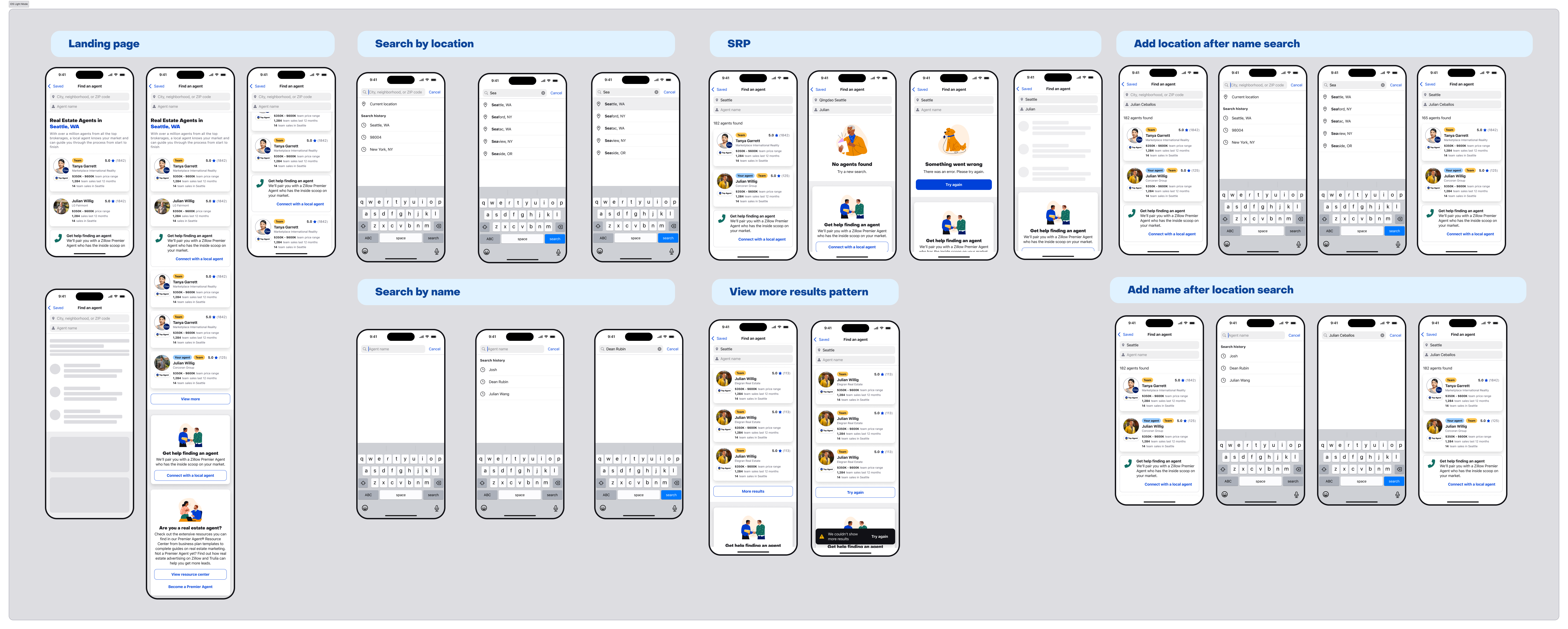
Native Agent Finder
Native Agent Finder
from zero to shipped
The first fully native agent discovery experience on Zillow — landing page, search, results, ingress entry points, and a Sponsored agent system.


impressions
submit contact info
from Agent Finder
ever on iOS & Android
Problem Statement
Half of Zillow's users had no native way to find an agent.
Agent Finder was Zillow's highest-converting agent surface — users who arrived via Agent Finder were 6× more likely to submit contact information than average. Yet for 50%+ of Zillow's users on mobile, this experience was delivered through a slow embedded webview that missed native platform conventions, had no prominent entry points in the iOS or Android app, and couldn't support features like GPS-based location inference, native filters, or a Sponsored agent system.
"Currently, the agent directory is only available on mobile through webviews, making it inaccessible to nearly half of Zillow's traffic and resulting in a suboptimal customer experience."
Issues for Mobile Users
Three reasons the webview experience failed
The Opportunity
Agent Finder already over-indexed on conversions. We just had to make it reachable.
Before designing a single screen, the data made the business case undeniable. The gap was access — not product quality. Making this path native and discoverable for 50%+ of users on mobile wasn't a speculative bet. It was unlocking existing demand.
User Research · Agent Directory Ingress IA Report
One finding shaped the entire ingress strategy: don't push users before they're ready.
The IA working group synthesized 20+ research papers, decks, and reports across Research, Touring, ZIBs, and ZPA — examining competing agent-finding experiences, how buyers actually choose agents, and what they value most. The decision to place Agent Finder entry points on Saved Homes and Home Loans Tab — and nowhere else — came directly from this research.
"Users do not want to be pushed to an agent before they feel ready. Put Agent Finder where users are already comparison-shopping or planning financing, keep the messaging lightweight, and avoid interrupting people before they are ready for agent help."
— Agent Directory Ingress IA Report synthesis
Design Solutions
Five principles that shaped every design decision
Design Iterations
Key decisions that improved the native experience
Early designs opened with a hero image above the search bar. The visual was appealing but pushed the search bar and featured agents below the fold on smaller screens.
Removed the hero image entirely — utility over marketing. Featured agents now populate immediately from inferred location. Title refined to be more eye-catching.
Landing page and SRP each had distinct search bar implementations — different visual patterns, different interaction models. Made the experience feel inconsistent.
Aligned both surfaces to one reusable native search pattern, confirmed with the Constellation iOS team. Reduced visual complexity and cut engineering effort.
When an agent photo wasn't available, the card showed a broken placeholder — common in production data and especially visible at launch when profile completeness was variable.
Graceful initials-based avatar when photos are missing. Company logo intentionally hidden on load failure. Every card looks polished regardless of data completeness.